Gifts for Design-Obsessed Friends Who Notice Everything
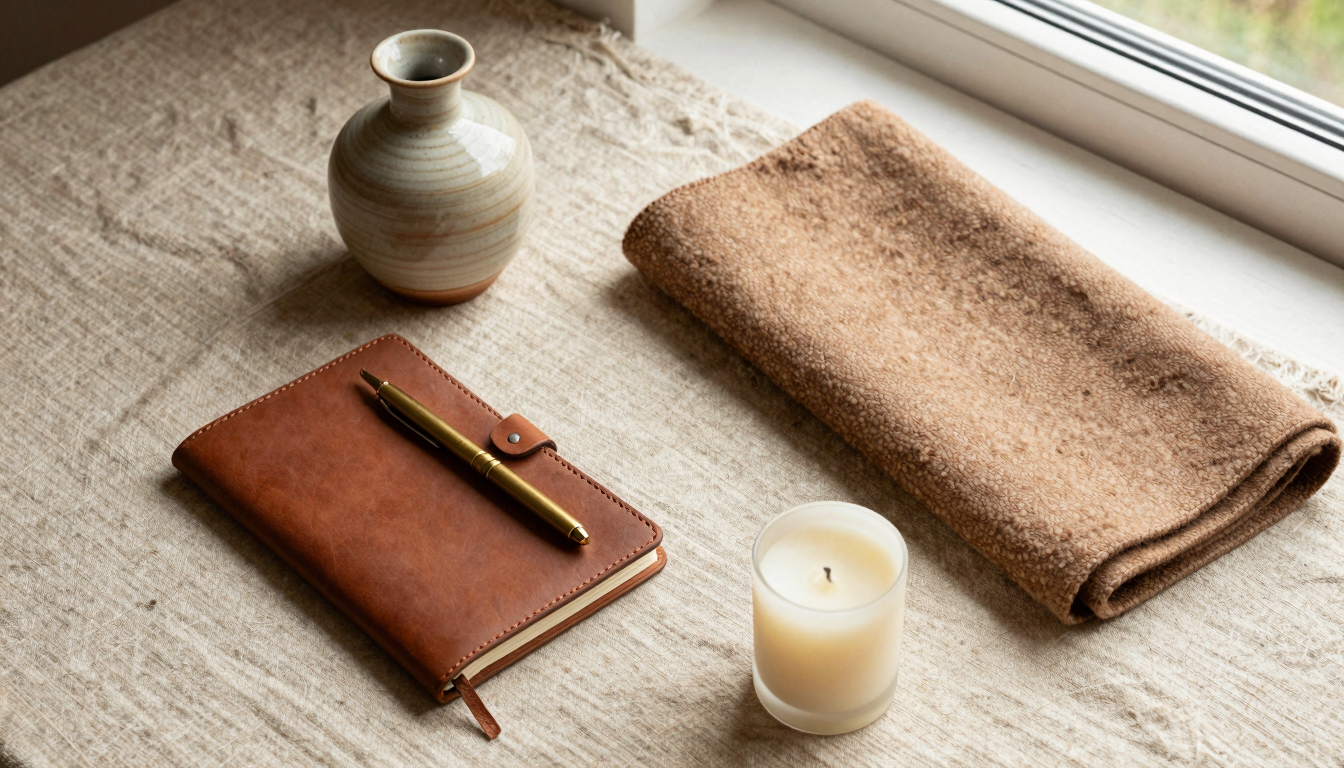
Shopping for someone who spent twenty minutes last week explaining why the wrong typeface on a cheese label ruins the whole experience? You're in the right place. The best gifts for design-obsessed friends aren't the most expensive ones: they're the ones that show you were paying attention too. Below, eight categories and a handful of very specific picks, sourced from the places design people actually shop, not the places everyone else does.
Why design lovers are the hardest people to shop for (and what that actually means for you)
The person who has strong opinions about grip texture on a water bottle does not need another candle. They've already sourced their candles from a ceramicist who fires her own holders in a kiln in Portugal, and the wax is soy-paraffin blend from a specific supplier in Ghent. The gift you're looking for isn't in the mainstream gift-guide rotation: it's slightly adjacent to the thing they love, precise where it could be vague, and ideally something they'd have bought for themselves but talked themselves out of.
According to data compiled by GiftAFeeling's 2025 gift research, 80% of consumers believe personalized gifts are more thoughtful than non-personalized ones, and Gen Z and Millennials prioritize customization at twice the rate of older generations. Your design-obsessed friend is almost certainly in that cohort. They want the gift that shows specificity of thought. A beautiful object, yes, but one that tells a small story about the giver's attention span.
This works because design people read objects. They understand that a decision was made: to use this finish, to leave this edge raw, to print on uncoated stock. The gift that honors that literacy lands completely differently from one that doesn't.
The under-$100 picks that punch above their weight
Design gifts don't have to be splurge-scale. Some of the best finds sit at $40-80, which is also the sweet spot where the recipient thinks "I would never have bought this for myself" rather than "I already own three of these."
For the friend who organizes their bookshelves by color and then reorganizes them by era:
UncommonGoods does a genuinely good job at this tier. Their sourcing pulls from independent makers and their curation has actual editorial backbone: not just "handmade," but handmade with a coherent point of view. Look specifically at their object-as-conversation-piece category: stoneware pieces with tool-mark textures, maps made from unexpected data sets, brass accessories that are practical before they're pretty.
Skip if: your friend is allergic to anything that reads as "artisan marketplace." Some design purists prefer institutional or anonymous objects: the hardware-store pen, the restaurant supply bowl. Know your person.

Objects for the friend who's building a considered home (piece by careful piece)
This is the person who bought one very specific lamp and then spent four months figuring out what goes beside it. They're not decorating, they're editing. They need one object that's coherent with what they're already doing, not a new direction.
Touch of Modern runs closer to this person's mental register. Their design objects tend toward the architectural: furniture with system logic, lighting with clear geometry, accessories that belong in a CAD file before they're realized in metal or wood. For someone mid-renovation or moving into a new space, a gift from their catalog reads as collaborative, not decorative.
Worth the splurge if: they've mentioned the word "proportion" in the last six months in a non-ironic context.
For the person who thinks handmade means something specific
Not all handmade is equal, and your design-obsessed friend knows it. They know the difference between a hand-thrown piece that shows the maker's intention and a mass "artisan-style" product that was injection-molded in a factory with a slightly irregular glaze applied for effect. They can tell. So you need to be able to tell too.
Etsy is large and uneven, but, navigated correctly, it's one of the best sources for genuinely bespoke objects that exist nowhere else. The design-specific slice of Etsy runs to letterpress-printed notebooks, ceramic pieces made in editions of twelve, hand-dyed linen, architectural models as art objects, and custom typeset prints that would survive close reading.
The key is to search with precision: not "handmade gift" but "lithograph edition print," not "personalized mug" but "stoneware reduced firing." Filter by location (US or EU for shipping reliability), sort by number of sales rather than recency, and look for makers who photograph their work like they care about it.
The detail that closes it: a maker with 200-400 sales and a two-year shop history hits the sweet spot: established enough to be reliable, small enough that the work hasn't been licensed or scaled.
A digression on books, because design people always need one more
Every design-obsessed person you know has a coffee table with a specific visual logic, and they need a book that fits it without looking like it was bought at the airport. The good news is that design publishing had a genuinely strong 2025-2026 run: monographs on mid-century Japanese industrial design, surveys of vernacular architecture from non-Western traditions, and at least two excellent histories of color in commercial printing that are also just beautiful objects.
If you're buying a book, buy the one they haven't seen yet, not the one everyone already has. The Taschen catalog is visible. The Lars Müller or Park Books catalog is not. That's where you want to be.
What we'd actually buy: the specific picks for different kinds of design people
Let's get granular. The person who describes themselves as a "systems thinker" wants gifts with logic: a modular storage solution, a notebook system, a cable management object that's also quietly beautiful. The maximalist who reads interior design accounts at midnight wants something that photographs well in their actual space. The friend restoring a mid-century apartment wants hardware: genuine Bakelite, vintage drawer pulls, a wallpaper sample kit from a revival brand.
The overlap in all of these: they want something that required a decision. Not "I bought you a nice candle" but "I found this specific thing from this specific maker and it made me think of the conversation we had about the George Nelson clock." That level of intention is what gifts for design-obsessed friends actually require.
A 2025 gifting industry report from PwC noted that 65% of consumers purchased personalized gifts last year, but the more useful data point for this audience is that design-literate consumers are significantly more likely to remember and discuss gifts they received that showed specificity of curation. The gift becomes a story they tell.
Should you splurge on one thing or curate a smaller collection?
This is the actual decision most people are stuck on. One $200 object or four $45-50 objects? Our honest answer: unless you know the one object well enough to know it's right, curate. Four things that tell a coherent story about what you know about this person will outperform one expensive thing chosen under uncertainty.
The exception: if they've mentioned something specific and you can source it exactly, get the specific thing. The person who said "I've been looking at that Danish ceramic studio but their shipping is brutal" is telling you what they want. Find the piece. Pay the shipping. It will land.
For the curation approach, think about pairing with contrast: something functional with something purely aesthetic, something old with something new, something mass-produced (but well-designed) with something one-of-one. The contrast is what makes it feel like a collection rather than a grab bag.